
When a business outgrows generic software, the real question isn’t whether to invest in custom development—it’s where. In 2026, an increasing number of startups, enterprises, and international organizations are turning to one answer: Custom Software Development in Dhaka. The city has evolved from a budget-friendly outsourcing footnote into a credible, full-stack technology hub—and the numbers back it up.
The State of Dhaka’s Software Industry in 2026
Bangladesh’s ICT sector has crossed a significant threshold. ICT exports surpassed $1.9 billion in 2024, and approximately 2,650 software companies are listed under the Bangladesh Association of Software and Information Services (BASIS). Dhaka sits at the center of this momentum—home to the country’s highest concentration of technology firms, engineering talent, and digital infrastructure.
Over 300,000 IT professionals now work across the country, with more than 50,000 developers specializing in software development, cloud, mobile, AI, and cybersecurity. The city is no longer just affordable—it is technically sophisticated. Global clients from the United States, the United Kingdom, Europe, and Australia are choosing Dhaka-based partners not to cut corners but to scale faster with capable engineering teams.
In 2026, buyers are not choosing Bangladesh for low rates alone. They are choosing it because many software companies now offer a combination of strong engineering quality, modern agile practices, and clear communication.
What Does Custom Software Development in Dhaka Actually Cost?
Cost transparency is one of the most important factors when evaluating a development partner. Here is what the current market looks like.
Custom software development in Bangladesh typically ranges from $3,000 to $100,000 or more, depending on project scope, features, timeline, and team expertise. Most companies also charge between $20 and $60 per hour.
To break this down further:
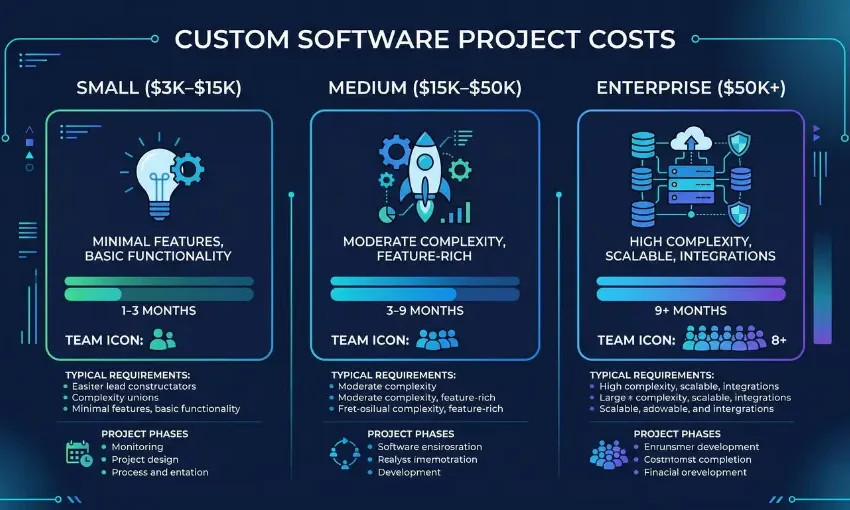
Small-scale projects—such as internal tools, simple portals, or lightweight applications—typically range from $3,000 to $15,000 and can often be delivered within a few weeks by a focused, lean team.
Medium projects — multi-module systems with dashboards, user management, and third-party integrations — typically cost between $15,000 and $50,000, with timelines spanning two to four months.
Large enterprise platforms—complex ERP systems, fintech platforms, healthcare management systems, or national-scale applications—often exceed $50,000 and require dedicated teams working across multiple quarters.
Outsourcing to Bangladesh reduces development costs by 40 to 70 percent compared to the U.S. market, making it a strategically sound choice for both startups managing runway and enterprises optimizing technology budgets.

Key Factors That Influence Your Project Cost
Understanding what drives the final price helps you plan realistically and avoid surprises mid-project.
Complexity and features. A simple customer portal costs a fraction of an integrated enterprise system. Every additional module — reporting, payment processing, API integrations, or real-time dashboards — adds development time and cost.
Integration requirements. Systems that integrate with payment gateways, CRM platforms, accounting tools, or external APIs demand additional development and rigorous testing to ensure accurate data exchange and long-term system stability.
Team seniority. Senior developers in Dhaka can command $80,000 to $150,000 or more annually at top firms, which reflects market maturation. A senior-led team costs more but delivers faster, cleaner, and more maintainable code—reducing long-term costs.
Engagement model. Fixed-price contracts work well for clearly scoped projects. Time-and-materials (T&M) models offer more flexibility for evolving requirements. Most successful projects in 2026 use a combined approach — fixed price for discovery and planning, then T&M for the main development phase — to reduce risks while preserving flexibility.
2026 Technology Trends Shaping Custom Software in Dhaka
The most forward-thinking software firms in Dhaka are not just building what clients ask for today — they are integrating the technologies that will define competitive businesses tomorrow.
AI-Native Development. Demand for AI engineering talent in Bangladesh has reached an unprecedented peak in 2026, with AI engineers now commanding a 12 to 15 percent salary premium over traditional software engineers. Top Dhaka firms are embedding machine learning, generative AI, and intelligent automation directly into custom platforms rather than treating them as bolt-on features.
AI-Assisted Development Speed. AI coding assistants have made mid-level developers significantly more productive, with a skilled developer using these tools able to produce output comparable to what a senior developer produced two years ago. For clients, this translates to faster delivery without sacrificing quality.
Fintech and HealthTech Specialization. Dhaka firms have built deep domain expertise in regulated industries. From core banking integrations to telemedicine platforms and insurance automation, specialist software houses are delivering solutions that match international standards.
Cloud-First Architecture. Modern custom software development in Dhaka is designed for the cloud from the outset—leveraging platforms like AWS, Azure, and Google Cloud to deliver scalability, reliability, and security that off-the-shelf solutions simply can’t match.
What to Look for in a Dhaka Development Partner
Choosing the right company matters more than choosing the right city. Here is a practical checklist for evaluating custom software firms in Dhaka.
Proven portfolio in your domain. A fintech startup should not hire a company whose only experience is in e-commerce. Ask for case studies that mirror your industry’s complexity and compliance requirements.
Transparent communication processes. Time zone differences between Dhaka (GMT+6) and Western markets are manageable—but only with structured stand-ups, clear sprint reporting, and dedicated project managers. Vague communication early in the conversation is a red flag.
Post-launch support commitment. Custom software is not a one-time transaction. Your partner should offer documented SLAs for bug fixes, maintenance, and feature updates after launch. Ask about this before signing any contract.
Technical stack alignment. Specialists in specific domains such as fintech, healthtech, and AI infrastructure are commanding 20 to 40 percent premiums over generalists with the same seniority level. Prioritize firms with deep expertise in your required stack over those claiming to do everything.
Honest project scoping. The best partners are honest about complexity, realistic about timelines, and clear about responsibility. If a software company makes everything sound easy, be careful.
Why Avientech Is Built for This Moment
At Avientech, we combine Dhaka’s competitive cost advantage with enterprise-grade engineering discipline. Whether you need a scalable SaaS product, a custom ERP system, a data-driven mobile application, or a complete digital transformation of your business operations, our team is equipped to deliver.
At Avientech, we go beyond simply writing code—we design tailored solutions aligned with your business objectives, timelines, and long-term growth strategy. Every project starts with a comprehensive discovery phase, ensuring that what we deliver is built specifically for your needs—not a one-size-fits-all template rebranded with your logo.
The Bottom Line
Custom software development in Dhaka in 2026 offers a compelling combination that is increasingly rare in global tech markets: competitive pricing, growing senior talent, modern AI-assisted workflows, and firms with genuine international delivery experience. The question for any business is no longer whether Dhaka is capable — it clearly is. The question is whether your chosen partner within Dhaka has the expertise, honesty, and structure to deliver your vision on time and on budget.
FAQs: Custom Software Development Dhaka
Q1. How much does custom software development cost in Dhaka in 2026?
Costs vary based on project scope and complexity. Small projects typically range from $3,000 to $15,000, medium-scale systems fall between $15,000 and $50,000, and large enterprise platforms can exceed $50,000. Hourly rates for Dhaka-based developers generally range from $20 to $60 per hour, depending on seniority and specialization.
Q2. Why should I choose a Dhaka-based company for custom software development?
Dhaka offers a rare combination of competitive pricing, a large pool of skilled engineers, and growing expertise in modern technologies like AI, cloud, and fintech. Compared to U.S. or European markets, outsourcing to Dhaka can reduce development costs by 40 to 70 percent — without sacrificing quality when you work with the right partner.
Q3. How long does it take to build custom software in Dhaka?
Timelines depend on the complexity of the project. A simple internal tool or portal can be delivered in 3 to 6 weeks. A medium-complexity platform typically takes 2 to 4 months. Large enterprise systems often require 6 months or more, depending on integrations, compliance requirements, and team size.
Q4. What types of custom software can Dhaka-based companies build?
Dhaka firms are experienced across a wide range of software types, including SaaS platforms, ERP and CRM systems, mobile applications, fintech and payment solutions, healthcare management systems, e-commerce platforms, AI-powered tools, and government or enterprise-grade web applications.
Q5. What engagement model is best for a custom software project — fixed price or time and materials?
For well-defined projects with clear requirements, a fixed-price model offers predictable costs and timelines. For projects where requirements may evolve, a time-and-materials (T&M) model provides more flexibility. Many successful projects use a hybrid approach — fixed price for the discovery and planning phase, then T&M for active development.


